
Whether it’s data from sales pipeline, inventory logs, or customer relation databases, modern enterprises generate millions of data points in just a second and in multiple systems. It’s not hard to gather this data; it’s hard to get insights from the noise. The inability to execute large, complex analytical reports on your operational databases causes system lag, slows down daily operations and hinders business growth.
A Business Information Warehouse fixes this structural issue.
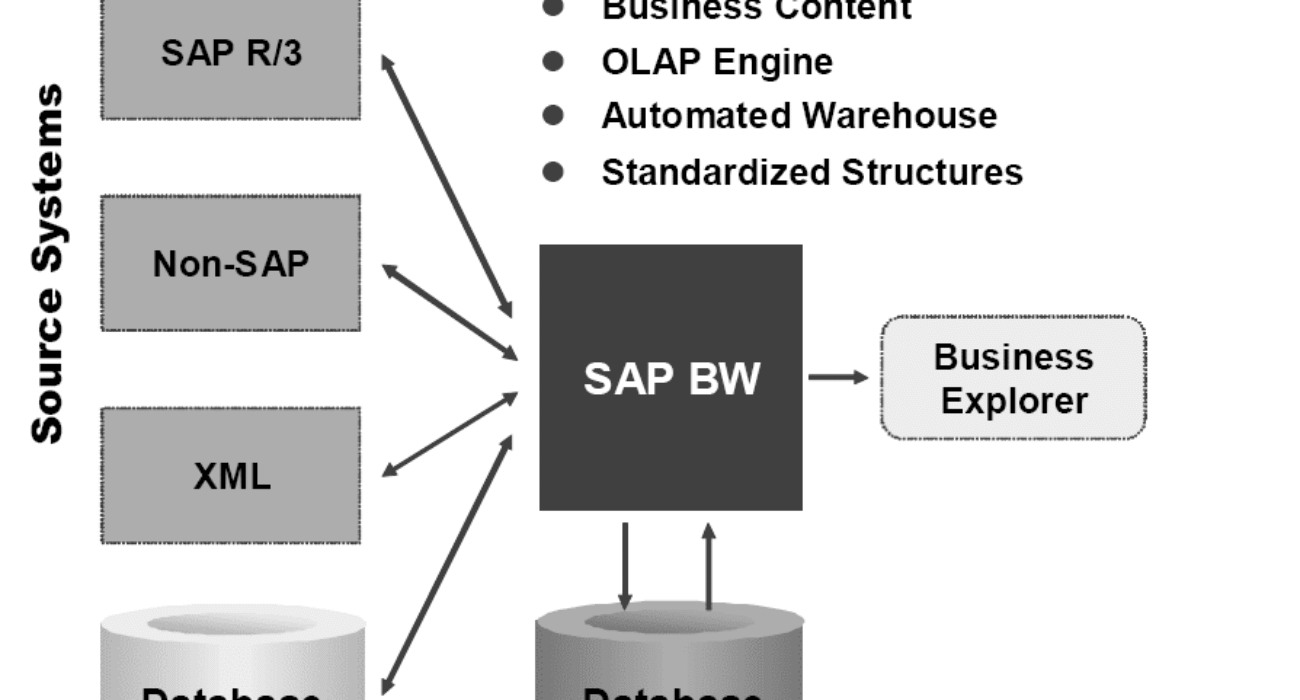
Originally popularized by enterprise software giant SAP as the SAP Business Information Warehouse (SAP BIW/BW), this specialized data platform consolidates, transforms, and stores vast amounts of data from virtually any internal or external source system. By decoupling daily transactional workloads from historical analysis, it provides a high-performance framework optimized specifically for multi-dimensional data modeling, reporting, and long-term strategic decision-making.
1. The Core Architecture of a Business Information Warehouse
A Business Information Warehouse operates as an independent, centralized backend server and data store. It acts as a specialized OLAP (Online Analytical Processing) engine that is separate from traditional OLTP (Online Transaction Processing) systems such as an active ERP system, where historical reporting data is stored.
The architecture is built on a multi-tiered foundation to meet the requirements of making reliable reports of sub-second response time on terabytes of information.
- Data Sources and Extractors: Custom software links built natively into source applications pull raw operational logs without impacting the performance of live applications.
- The Staging Area (Persistent Staging Method): A clean entry-point layer where raw extracted data lands before formatting. This allows the system to hold historical snapshots of operational changes over long operational timelines.
- The ETL Pipeline (Extraction, Transformation, Loading): The system cleanses incoming text strings, reconciles currency formatting inconsistencies, handles time-zone mapping, and filters out corrupted fields.
- The MetaData Repository: A central dictionary cataloging data structures, data ancestry maps, business definitions, and operational routing pathways.
2. Advanced Data Modeling and Storage Mechanics
Inside the warehouse core, data undergoes structured modeling to optimize it for fast, multi-dimensional querying.
InfoObjects: The Fundamental Building Blocks
A warehouse splits incoming data streams into two distinct structural categories called InfoObjects:
- Characteristics: Non-measurable, descriptive context points used for data grouping, filtering, and sorting (e.g., Customer IDs, Region Codes, Material Types).
- Key Figures: Numeric value fields and metrics that undergo analytical math and aggregations (e.g., Net Revenue, Total Units Sold, Profit Margins).
From InfoCubes to Advanced DataStore Objects (ADSOs)
Traditionally, warehouses have been organized in a manner that applies multi-dimensional data sets, known as InfoCubes, which arrange data into extended star schemas with a fact table in the middle and descriptive dimension tables.
When classic structures were adapted to modern systems and these became ultra fast in-memory databases such as SAP HANA, these became Advanced DataStore Objects (ADSOs). Instead of a complex structure with multiple layers of physical schemas, ADSOs use simple relational schemas designed for faster column-oriented data storage and processing, which is beneficial both in terms of reporting performance and data load speed.
3. Technology Comparison: Classic Relational vs. Modern In-Memory
The underlying database layer completely dictates how fast an information warehouse scales and how quickly analysts receive report details.
| Architectural Feature | Classic Warehouse (Relational Database) | Modern Warehouse (In-Memory / SAP HANA) |
| Storage Architecture | Disk-based file storage arrays | Direct High-Speed RAM Compute |
| Data Aggregation Method | Pre-calculated summaries required to avoid lag | Real-time calculation on raw transactional tables |
| Data Latency | High; batch transfers run on nightly or weekly cycles | Low; real-time or near-instantaneous streaming |
| System Layer Complexity | Complex multi-tier architectures (Cubes, Aggregates) | Simplified, highly consolidated flat data structures |
| Hardware Overhead | High performance maintenance & indexing needed | Lower Total Cost of Ownership (TCO) through code pushdown |
4. Real-World Value: Why Modern Enterprises Deploy an Information Warehouse
Investing in a premium Business Information Warehouse offers significant operational advantages for expanding corporations:
Standardizing a Single Source of Truth
Global corporations frequently deal with data conflicts, such as different international branches running separate sales tracking apps that format regional names or currency data differently. A Business Information Warehouse forces incoming data streams through unified ETL pipelines, providing executive teams with clean, standardized numbers that accurately reflect the entire corporation’s performance.
Deep Granular Security and Access Control
Corporate data warehouses feature robust security frameworks that restrict access based on specific business roles or divisions. Administrators can create rules that allow regional managers to view specific regional profit margins, while shielding underlying corporate accounting logs or sensitive client biometrics from unauthorized internal viewing.
Bridging On-Premises Legacies to the Cloud
Modern implementations allow teams to preserve decades of historical legacy data through unified Business Data Fabrics. Instead, enterprises can leverage hybrid data cloud platforms to turn their in-house database objects into data products that can be accessed in the cloud; third-party tools and machine learning engines can then access the historical context without the need for risky full-system overhauls.
Frequently Asked Questions
What is the primary difference between a Data Warehouse and a Data Lake?
The data in a Data Warehouse is highly organised and carefully modelled relational data that has been cleansed and optimized for fast business intelligence reporting. A Data Lake, on the other hand, is a large data repository that stores unstructured data in its raw state until it’s transformed by an analyst for a particular project – such as a raw video file, text documents, or API logs.
How has artificial intelligence affected the Business Information Warehouse?
Modern information warehouses integrate advanced AI capabilities directly into the database engine. Historical warehouse models can be plugged into sophisticated analytics applications, enabling companies to perform predictive machine learning workflows, risk modeling and automation of repetitive data management chores with an abundance of trusted enterprise information.
Can non-SAP software tools connect to an SAP Business Warehouse?
Yes. While built to naturally complement native SAP ERP architectures, modern Business Information Warehouses feature open-ended public APIs and data connection adapters. This enables business intelligence applications like PowerBI, Tableau, and custom analytics front-ends to safely query, extract, and display stored database structures.